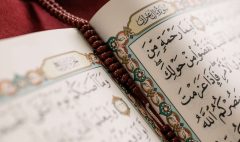
What Is Sanad in Qurʾān Recitation?
A student was scrolling through Quran course listings late one night.
He had been searching for a program to improve his recitation. He had found dozens. Some offered certificates. Some offered “internationally recognized” credentials. Some offered something called an ijāzah. And almost all of them mentioned, somewhere in the fine print or the FAQs, a word he had never once heard explained.
Sanad.
He searched for a definition. He found technical descriptions that assumed he already understood what the word implied. He found forum discussions where people used it casually, as though everyone knew what it meant. He found a few sentences here and there that mentioned something about a chain going back to the Prophet ﷺ.
But no one had sat down and told him, from the beginning, what sanad actually is. Why it exists. How it works. What it means for every Muslim who recites the Quran — whether they know the word or not.

This article does that.
It is for the student who has never heard the word. It is for the Muslim who has heard it many times but never had it fully explained. And it is for anyone who has ever wondered: how do we know the Quran we recite today is the same Quran the Prophet ﷺ recited fourteen centuries ago?
The answer to that question is the sanad.
The Word Itself
Sanad (سَنَد) is an Arabic word. Its root means to lean on something. To be supported by something. To have a backing.
When you lean against a wall, the wall is your sanad. When a claim is supported by evidence, the evidence is its sanad. When a narration can be traced back to its source through a chain of transmitters, that chain is the sanad.
In Islamic scholarship, the word acquired a specific technical meaning: the documented chain of people through whom a piece of knowledge was received and transmitted, going back to the original source.
Every authentic hadith has a sanad. A narrator says: “Abu Bakr told me, who heard from Umar, who heard from the Companion, who said the Prophet ﷺ said…” That sequence of names — Abu Bakr, Umar, the Companion — is the sanad. It is the documented path through which the narration traveled from the Prophet ﷺ to the person now repeating it.
The same principle applies to Quranic recitation. Every authenticated form of the Quran — every specific way of reciting that has been transmitted from the Prophet ﷺ — has a sanad. A chain of human beings, each one receiving the recitation from the person before them, going back to a Companion who recited directly to and from the Prophet ﷺ himself.
That chain is the sanad. And it is what distinguishes an authentic transmission from a personal version.
Why a Chain Was Necessary
This question is worth pausing on. The Quran exists in written form. Why was a chain of oral transmission necessary at all? Why couldn’t Muslims simply read the written text?
The answer is in the nature of the Quran itself.
The Quran is an oral revelation. It was spoken. It was heard. It was transmitted through the human voice long before it was written on parchment or paper. When the Angel Jibreel brought the first revelation to the Prophet ﷺ in the cave of Hira, the word was not: “Write.” The word was: “Iqra’.” Read. Recite.
The Quran is a recitation. Its name means recitation. Its proper form is sound — the sound of a human voice producing specific letters from specific points of articulation, with specific qualities, in specific patterns of lengthening and stopping.
Those properties of sound cannot be fully captured in writing. Arabic script records the consonants and some vowels. It does not record the quality of each letter — whether heavy or light, whether with or without echo. It does not record the precise duration of lengthenings. It does not record the exact articulation point of each sound. All of that lives in the voice. And the only way to transmit what lives in the voice is through the voice.
A text can be copied. But a text alone cannot transmit the full specification of how the Quran sounds. That specification requires a human chain — a sequence of teachers and students, each one receiving the full sonic reality of the recitation and passing it forward.
The sanad is the documentation of that chain.
Ustadh Mahmoud, who has taught Quranic sciences for over fifteen years, described this distinction to his students this way: “Imagine I write down every rule of Arabic pronunciation I know. Every makhrāj, every sifah, every tajweed rule — all written in perfect detail. I give you that document. Can you now recite the Quran correctly? No. Because the sound is not in the document. The sound is in a human throat, trained by another human throat, trained by another, going back to the Prophet ﷺ. The chain is not a bureaucratic formality. It is the only mechanism that can transmit what is being transmitted.”
How the Sanad Began: The First Links
The sanad of Quranic recitation begins with the Prophet ﷺ himself.
Allah revealed the Quran to the Prophet ﷺ through the Angel Jibreel. The Prophet ﷺ memorized it as it was revealed. He recited it in his prayers. He taught it to his Companions — not through dictation alone, but through live oral transmission. They sat with him. They listened to him recite. They recited back to him. He corrected them. He affirmed them. He taught them until what they produced was what he had received.
This method — reciting to a qualified teacher and being corrected in real time — has a name in Arabic: talaqqi. It is the method of reception. And it is the method by which the sanad begins.
The Prophet ﷺ himself designated specific Companions as teachers of the Quran and sent them to different regions. He said: “Take the Quran from four: Ibn Mas’ud, Ubayy ibn Ka’b, Mu’adh ibn Jabal, and Salim Mawla Abi Hudhayfah.” These were not the only people who knew the Quran. They were the people the Prophet ﷺ specifically identified as reliable transmitters — people whose recitation could be trusted and from whom others should learn.
Each of these Companions became the first human link in a transmission chain. Students sat with Ibn Mas’ud in Kufa and received from him what he had received from the Prophet ﷺ. Students sat with Ubayy ibn Ka’b in Madinah and received from him. Their students taught their students. Each generation received from the one before and transmitted to the one after.
That process — begun when the Prophet ﷺ first recited to Abu Bakr and to Aisha and to his Companions — is the process that is still running today.
Yasmin, a student who traced the sanad of her own riwāyah back to its first links, described the experience: “I was following the names in the chain, generation by generation, going backward. And then I reached Abu Abd Al-Rahman Al-Sulami — a Companion who received directly from Ali ibn Abi Talib and Uthman ibn Affan, who received from the Prophet ﷺ. I stopped at that name. This is a person who sat in the same room as the Prophet ﷺ and heard him recite. And I am connected to that moment through a chain of human beings that I can name. That is not a metaphor. That is historical fact.”
The Architecture of a Sanad: How It Is Structured
A sanad in Quranic recitation has a specific architecture. Understanding it requires knowing three terms.
The first is qirāʾāt — the tradition itself. There are ten canonical traditions of Quranic recitation, each named for a leading imam who mastered and systematized a specific transmitted form of the recitation. These imams — Nafi’, Ibn Kathir, Abu ‘Amr, Ibn ‘Amir, ‘Asim, Hamzah, Al-Kisa’i, Abu Ja’far, Ya’qub, and Khalaf — were not inventors. They were the most trusted transmitters of their generation, and their names became attached to the traditions they preserved.
The second is riwāyah — the primary transmission of a specific imam’s tradition. Each imam’s tradition was received and transmitted by multiple students. The two most prominent students of each imam gave rise to named riwāyāt. The most widely used riwāyah in the world today is Hafs ‘an ‘Asim — the transmission of Hafs, from his teacher ‘Asim, from the Imam of the Kufan tradition. This full name is itself a summary of the sanad: Hafs received from ‘Asim received from Al-Sulami received from the Companions received from the Prophet ﷺ.
The third is tariq — the specific chain within a riwāyah. Each primary transmitter had many students. Each of those students transmitted to their students. The full sanad of a specific recitation maps every link in this chain — not just the imam and the primary transmitter, but the complete documented path from the current time back to the Prophet ﷺ.
When a teacher grants an ijāzah — a formal authorization to transmit — the written document they give includes this complete chain. Every name. Every generation. The student’s name at the bottom. The Prophet ﷺ at the top. The full sanad, from the present moment all the way back to its source.
What Makes a Sanad Valid
Not every chain is equal. The scholars of Islamic scholarship developed precise criteria for evaluating the strength of a sanad — criteria originally developed for hadith evaluation and applied with the same rigor to Quranic recitation.
Ibn Al-Jazari (d. 833 AH) — the most authoritative scholar in the history of qirāʾāt sciences — established three conditions that every canonical recitation must meet. All three are simultaneously conditions on the sanad itself.
The first condition is conformity with classical Arabic grammar. A reading that violates the established grammar of the Arabic language cannot be canonical, regardless of what chain supports it.
The second condition is conformity with the Uthmanic Mushaf — the standardized written text compiled under Caliph Uthman ibn Affan and distributed across the Muslim world. A reading that contradicts this text cannot be canonical.
The third condition — and the one that specifically makes the sanad the center of the system — is authentic transmission. The reading must be traceable through a verified chain of reliable transmitters back to the Prophet ﷺ. Without this, even a reading that conforms to Arabic grammar and matches the written text is not a canonical qirāʾāt. It is a personal reading. The chain is what makes it more than personal.

These three conditions working together produce a system that is resistant to fabrication, error, and corruption in a way that written transmission alone could never achieve.
Omar, a student of hadith sciences who came to qirāʾāt study after years of studying isnad evaluation, described the elegance of the system: “When I applied the criteria I had learned for evaluating hadith chains to the chains of Quranic recitation, I found something remarkable. The qirāʾāt chains are more thoroughly documented, more widely cross-verified, and transmitted at a higher standard of mass narration than almost any hadith in existence. The system that was developed to protect the Sunnah — the science of isnad evaluation — when applied to the qirāʾāt, produces the highest possible confidence in what is being transmitted. The Quran’s oral preservation is the peak expression of what Islamic transmission science was built to achieve.”
The Sanad as Living Proof
Here is what the sanad means in practice for every Muslim who recites the Quran today — whether they know the word or not.
When a Muslim opens a Mushaf and recites Al-Fatiha in the riwāyah of Hafs ‘an ‘Asim — the most widely used recitation tradition globally — what they are producing is not a personal interpretation of written text. They are reproducing a specific sound, with specific properties, that was transmitted to them from their teacher, who received it from their teacher, in an unbroken oral chain that — if followed link by link, name by name — reaches a Companion who sat with the Prophet ﷺ and heard him recite those exact words in that exact form.
The sanad is the proof that this is so. It is not a claim made on faith. It is a historical fact, documentable through named human beings whose biographies can be researched, whose reliability was evaluated by scholars of their own time, and whose transmissions cross-verify against each other at every generation.
This is why the Islamic tradition has always insisted on the sanad. Not as a formality. Not as a credential. As the mechanism of preservation itself.
Studio Arabiya’s certified ijāzah programs are built around this understanding. Their Ijāzah Programs in Quran Recitation (Tajweed) and Quran Memorization (Hifz) carry a strong sanad to Prophet Muhammad ﷺ — with teachers who hold documented, verified chains, offering live one-on-one transmission through the same talaqqi method that the Companions used to receive from the Prophet ﷺ himself.
That last phrase — the same method the Companions used — is not marketing language. It is a description of what the sanad system requires. Sitting with a teacher. Reciting. Being corrected. Reciting again. Until what you produce is what was transmitted to you, accurately and completely.
The method has not changed. It has never needed to.
Why Every Muslim Should Know This Word
The student who was scrolling through course listings late at night was not looking for academic information about Islamic transmission theory. He was looking for a Quran course. He wanted to recite better. He wanted to feel more connected to what he was reciting.
What he did not know is that the answer to all three of those desires is connected to a single word. Sanad.
The sanad is why his recitation — even now, even before he has ever heard this explained — is connected to something older and more significant than his own learning. The tradition through which he received the Quran, however informally, traces to teachers who traced to teachers who traced to the Companions.
The sanad is what makes the Quran’s preservation not a belief but a historical verification.
And the sanad is what becomes formally, documentably, personally his — when he sits with a qualified teacher who holds a verified chain, recites the complete Quran under their assessment, and has his name added to the chain as its next link.
At Studio Arabiya, the certified ijāzah journey begins with the foundations — reading fluency, consistent tajweed, and for the Hifz track, complete memorization — and moves through live, one-on-one recitation sessions with a qualified chain-holding teacher, resulting in a formal ijāzah document that names the student in the chain and empowers them to teach and transmit in turn.
The chain has been running for fourteen centuries. It is running right now — in living rooms and masjids and online classrooms around the world, wherever a qualified teacher is listening to a student recite and correcting what needs correcting.
The chain has never broken.
It is waiting for the next link.
Bismillah. Become part of it.