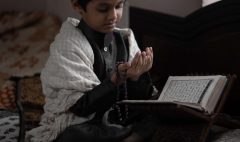
Stories of the Sahabah for Children
A boy came to his father at bedtime with a question.
He was seven. His class had been studying Umar ibn Al-Khattab that week. He had heard how Umar was so feared before Islam that even shaytan would take a different road to avoid him. He had heard how Umar cried when he heard Quran and became Muslim. He had heard how Umar became the second caliph of Islam.
He lay in bed and looked at the ceiling.
“Baba,” he said, “can a mean person become a good person?”
His father sat on the edge of the bed.

“What do you think?” he said.
“I think yes,” the boy said slowly. “Because Umar did.”
The father did not answer. He did not need to. His son had just done something that took the boy’s whole education to produce. He had taken a story he had heard and applied it to a question his own life was raising. Not a question about Umar. A question about a classmate who had been unkind to him all week.
He was not asking whether Umar could change. He was asking whether his classmate could change. Whether the cruelty he had experienced was the final word on who that person was.
The story of Umar gave him the answer before the question was fully formed.
That is what Sahabah stories do at their best. They are not history lessons. They are answers to questions children are already carrying. They are given before the questions are asked, so that when the questions arrive, the answers are already there.
Why Stories Work When Definitions Fail
Children do not learn values from definitions. They learn them from people.
Tell a child that courage is acting rightly despite fear and they understand a definition. Show a child a person who was afraid and acted rightly anyway and they understand something that the definition cannot carry.
The Companions are among the most documented human beings of their era. Their stories are preserved in the hadith collections, in the Seerah literature, in the biographical dictionaries that Islamic scholarship produced across fourteen centuries specifically to keep these memories available for every generation that came after.
Those stories are not preserved for academic interest. They are preserved because they are the most powerful transmission mechanism for Islamic character that has ever existed. Not rules. Not commands. Specific people, in specific moments, making specific choices that cost them something real.
A child who hears that Muslims should be generous has received an instruction. A child who hears the story of Abd Al-Rahman ibn Awf arriving in Madinah with nothing, being offered half of his Ansar brother’s wealth, and asking only to be shown where the market was so he could begin working, has received something different. They have seen what generosity looks like from both directions: the one who gives without keeping score and the one who receives without becoming dependent.
The instruction tells a child what to do. The story shows them what it looks like to actually do it. And seeing it is different from being told it.
Ustadha Nadia, who has been teaching Seerah and Companion stories to children for over ten years through both classroom settings and one-on-one instruction, described what she watches happen when a story genuinely lands: “Something changes in a child’s face when a story has gotten through to them. It is not the look of understanding a lesson. It is the look of having just met someone. They go quiet in a different way. I can always tell when a Companion story has landed because the child becomes still and then asks a question that is personal. Not about the Companion but about their own life. The story opened something in them and now they are looking at what it opened.”
Stories for Courage: When the World Says No
The stories of the Sahabah that teach courage are among the most powerful for older children, particularly those between the ages of eight and twelve.
At this age, children begin encountering the specific form of social pressure that Islamic identity most frequently collides with. The group does something wrong and everyone is expected to join in. The popular opinion is the wrong opinion. Saying what is true means saying what is unpopular.
The Sahabah faced this in its most extreme form. They said yes to Islam when the entire social structure of Makkah said no. They maintained what they believed in the face of mockery, social exclusion, physical persecution, and the loss of everything that made their lives materially comfortable.
The story of Musab ibn Umayr is one of the most powerful for this age group. He was young and wealthy and known for the finest clothing in Makkah. He accepted Islam and was cut off from his family’s support immediately. He went from wearing the finest garments in the city to wearing clothes held together with thorns. He was sent by the Prophet ﷺ to Madinah as the first teacher of Islam before the Hijrah. He traveled alone to a city he did not know and built the foundation of the Muslim community there from nothing.
He died at the Battle of Uhud. There was not enough cloth to cover his whole body. The Companions covered his face with it and placed grass over his feet. The Prophet ﷺ wept over him and recited the ayah: “Among the believers are men who have been true to their covenant with Allah.” (33:23)
For a child who is deciding whether to tell the truth in a moment when lying would be easier, or whether to stand apart from a group that is doing something wrong, the story of Musab is not an abstract lesson about courage. It is evidence that the choice they are facing is the same kind of choice that the Companions faced. And the Companions chose.
Studio Arabiya’s Islamic Studies for Kids curriculum covers the stories of the Companions as part of its Seerah component, taught by Al-Azhar certified teachers in live, one-on-one sessions. Children engage the Companion stories interactively, asking questions and making connections, rather than receiving them passively as facts to be memorized. This interactive format is what allows the stories to function as answers to questions children are already carrying rather than as additional information to store.
Stories for Honesty: When the Truth Is Costly
Children understand that honesty sometimes costs something. They face this at ages much younger than adults realize. The small lie that would avoid a consequence. The silence that would protect a friendship. The exaggeration that would make a story better.
The Companion stories that specifically address honesty are those where the truth cost the speaker something real and they chose to pay the cost.
The story of Ka’b ibn Malik is one of the most detailed and emotionally complete stories of honesty in the entire Seerah. Ka’b was a Companion who failed to join the Prophet ﷺ on the Tabuk expedition without a genuine excuse. When the expedition returned and the Prophet ﷺ asked those who had stayed behind to explain themselves, most gave false excuses. Ka’b, along with two other Companions, told the truth. They had no excuse. They had simply failed.
What followed was one of the most challenging periods in Ka’b’s life. For fifty days, the Prophet ﷺ did not speak to him on the command of Allah. His fellow Muslims stopped greeting him. He sat in his own city, surrounded by people who did not acknowledge his existence, holding the truth that had placed him there.
Then the revelation came. His repentance was accepted. Allah mentioned his name in the Quran: “And upon the three who were left behind.” (9:118) His name in the Quran because he told the truth when the entire community was offering him an easy way out.
For a child who is deciding whether to tell the truth about something they did, the story of Ka’b ibn Malik offers a specific and powerful message: telling the truth when it is hard is one of the most important choices you can make, and Allah honors that choice in ways that a small comfortable lie can never produce.
Stories for Resilience: When Everything Goes Wrong
Some of the most important Companion stories for children are the ones where things go badly and the Companion continues anyway.
Children need these stories because childhood, contrary to the assumptions of comfortable adulthood, is full of things going badly. Plans falling apart. Friendships breaking. Expectations not met. Results that do not match effort.
The story of Khabab ibn Al-Aratt is not often told to children, but it should be. He was a blacksmith in Makkah who accepted Islam early. His owner was a woman who hated the Prophet ﷺ and tortured Khabab specifically to force him to recant. She pressed red-hot coals against his back until they went cold.
He went to the Prophet ﷺ and asked: “Will you not pray to Allah for us?” The Prophet ﷺ was sitting with his back against the Ka’bah. He sat up and said: “Among those before you, there was a man who would be placed in a trench and sawn in two from his head to his feet, and that would not turn him away from his religion. And Allah will certainly complete this matter, until a rider travels from Sana’a to Hadramawt fearing nothing except Allah.”
He was not dismissing Khabab’s suffering. He was placing it in the largest possible context. The suffering is real. The completion of this matter is also real. And the completion is larger than the suffering.
For a child who feels that their difficulty is too large to survive, this exchange offers exactly what the Prophet ﷺ intended it to offer: perspective that does not minimize the pain but refuses to let the pain become the final word.
Studio Arabiya’s Seerah courses introduce children to the full range of Companion experiences, including the stories of difficulty and perseverance that are often omitted from children’s Islamic education in the mistaken belief that children cannot handle them. Children who encounter these stories with a skilled teacher who knows how to frame them appropriately develop a resilience that sanitized stories cannot produce.
Stories for Generosity: When Giving Costs Something Real
Young children are natural hoarders. The developmental task of the early years is precisely the movement from “mine” to “ours” to “theirs.” Islamic character education must work with this developmental reality rather than against it.
The most powerful generosity stories in the Sahabah tradition are not the ones where generosity was easy. They are the ones where generosity cost something and the Companion gave anyway.
Abu Talha Al-Ansari was a wealthy man in Madinah whose most prized possession was a garden called Bayruha. It was the finest garden in Madinah, facing the masjid of the Prophet ﷺ. When the ayah was revealed: “You will never attain righteousness until you spend from what you love” (3:92), Abu Talha went immediately to the Prophet ﷺ and said: “My most beloved property is Bayruha. I give it as charity for the sake of Allah.”

The Prophet ﷺ said: “Well done. That is profitable wealth. I have heard what you said, and I think you should divide it among your relatives.”
Abu Talha did so.
For a child who has been told to share, this story is different from the instruction. It is a man who gave away the thing he loved most, not the thing he had too much of. That is the specific quality of Islamic generosity: not the surplus, but the beloved thing.
A child who carries this story carries a different understanding of what generosity means than a child who only knows the rule.
How to Tell the Stories: The Method Matters
The most important factor in whether a Companion story reaches a child is not the story itself. It is how the story is told.
A story told as information produces information. A story told as a meeting between the child and the person in the story produces something else.
The difference is in the telling. A parent who says “Bilal was a Companion who was tortured for his faith and refused to renounce” has conveyed information. A parent who says “Imagine you are lying on the hot sand in the middle of the afternoon, and someone has placed a boulder on your chest, and they tell you: just say the words and it will stop. And you say nothing except: One. One.” has placed the child inside the story.
That placement is what allows the story to function as the father’s son experienced it: as an answer to a question the child is already carrying.
Specific techniques matter. Telling the story before delivering the lesson, so the child arrives at the lesson themselves rather than receiving it prepackaged. Pausing at the moment of choice and asking the child what they would do before revealing what the Companion did. Following up after the story with a question that connects it to the child’s actual life.
And asking the question the father asked his son, the question that requires the child to do the interpretive work themselves: “What do you think?”
That question, asked after a Companion story has been told with care, is one of the most powerful Islamic education tools available to any parent. It transforms the child from a listener to a thinker. It puts the lesson in their hands rather than delivering it to them complete.
Studio Arabiya’s live, one-on-one teaching format specifically enables this kind of interactive, question-driven engagement with Companion stories. A teacher who knows a single child, who has been teaching them across multiple sessions, who knows what questions they tend to ask and what connections they tend to make, can tell a Companion story in a way that is tailored to that specific child’s current life and current questions. No group class can do that. Personalized instruction with a certified teacher is what allows the Sahabah stories to do what they are meant to do.
The Stories That Last the Longest
The father whose son asked whether a mean person can become a good person because of Umar’s story gave his son something that morning that the son will carry for decades.
Not a lesson about Umar. A framework for how to see other people. A belief, grounded in historical evidence, that the person in front of you is not yet finished becoming who they will be. That cruelty is not necessarily the final word on who someone is. That transformation happens. That it happened to one of the greatest human beings who ever followed the Prophet ﷺ.
That framework will serve that boy when he is twenty-five and dealing with a difficult colleague. When he is forty and watching someone he loves go through a change he did not expect. When he is fifty and asking himself whether the parts of his own character he is not proud of are permanent.
The Companion story planted in childhood grows with the person who received it. It arrives at each new moment of the person’s life carrying the weight of fourteen centuries of documented human transformation.
That is why the stories matter. Not because they are inspiring. Because they are true. And truth, planted early in a willing heart, outlasts almost everything else.
Bismillah. Tell the next story tonight.